
History of the Oxford Female Institute
A Building with a Story Worth Telling
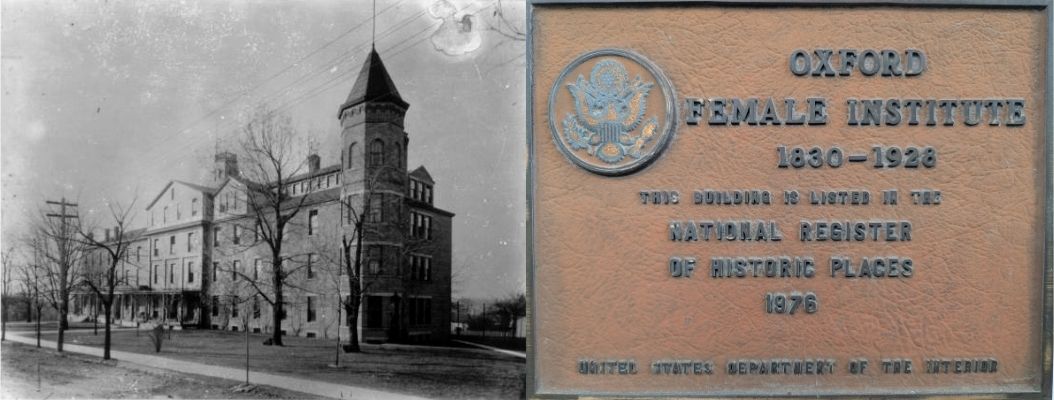
The building at 10 S. College Avenue has stood at the heart of Oxford since 1850. Listed on the National Register of Historic Places since 1976, it has educated women, housed a First Lady's early years, and survived long enough to become one of Southwest Ohio's most storied addresses. Today, it's home to the Oxford Community Arts Center.
The Oxford Female Institute, 1830-1928
In 1830, Bethania Crocker was tasked by three prominent Oxford figures, Dr. John Witherspoon Scott, Robert Hamilton Bishop, and William Holmes McGuffey, to establish a school for girls in Oxford. By 1839, the school had evolved into the Oxford Female Academy, and in 1849, it was officially chartered as the Oxford Female Institute, moving into a newly built, two-story brick building on the corner of College and High Streets in 1850. Dr. Scott, a former instructor at Miami University, served as the first President.
The school grew steadily. By 1856, a new three-story building stood to the south of the original school, and a latticed walkway on the second floor connected the two buildings. By the end of the 1880s, the two structures had been connected with additions including a north wing, a library, a chapel, and additional classrooms.
By the mid-1850s, Oxford was home to two thriving colleges for women - the Oxford Female Institute and the Oxford Female College, located on a hill overlooking the northeast of Oxford (formerly Miami University's Fisher Hall, now site of the Marcum Center). Recognizing the strain of sustaining both, the schools merged in 1867 and were eventually renamed Oxford College in 1890. The school was re-chartered in 1906 as the Oxford College for Women.
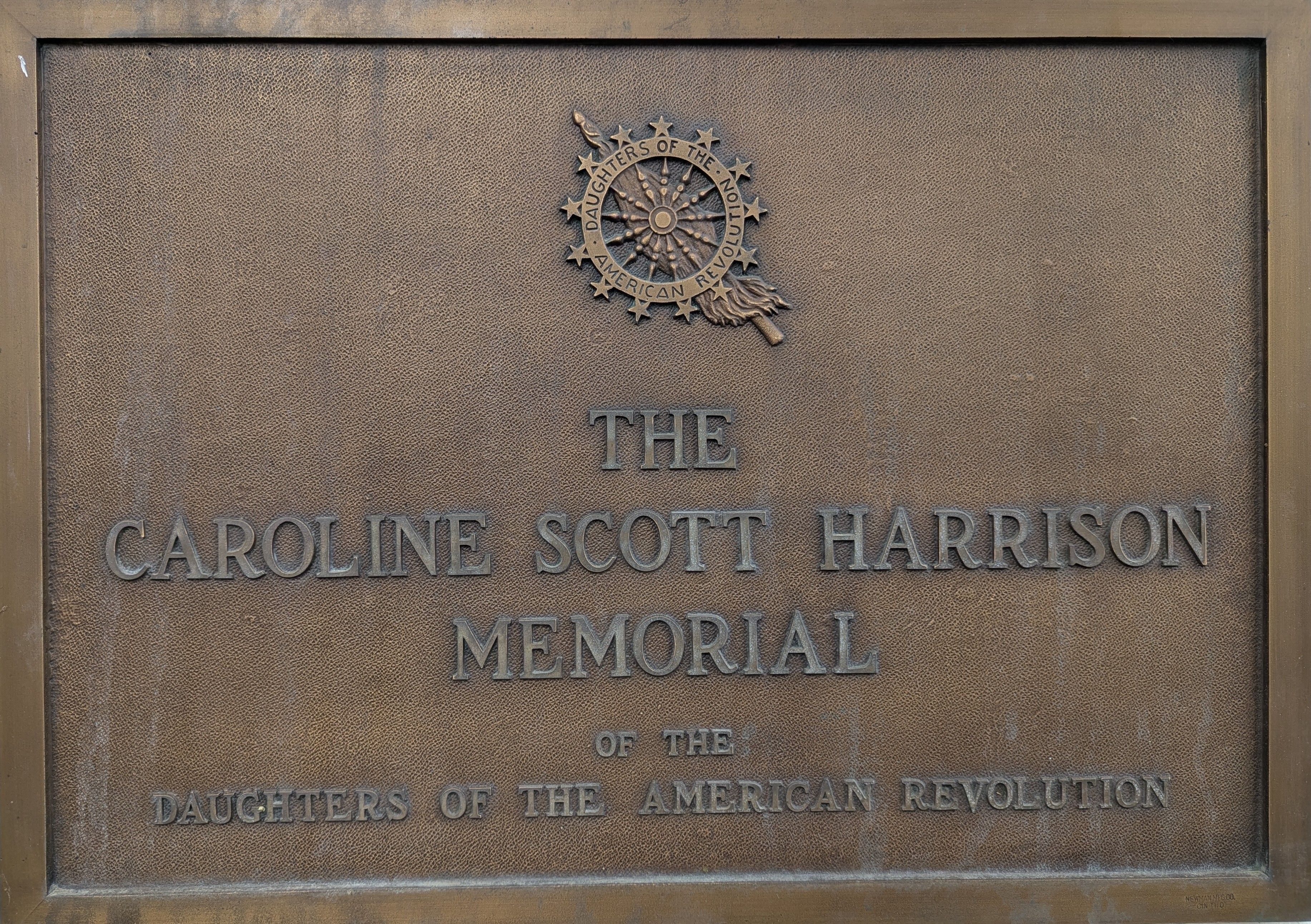
By 1928, Oxford College faced serious financial difficulties. The college closed, and Miami University acquired the property. Architect Robert Harsh remodeled the early 1900s Queen Anne structure into a unified building with a neo-Georgian facade. The Brant Ballroom, the final addition, was completed in 1930 with funds raised by the Daughters of the American Revolution (DAR) in honor of First Lady Caroline Scott Harrison and dedicated in honor of Mary Bowdle Brant, a prominent Cincinnati member of the DAR.
Caroline Scott Harrison - Oxford's First Lady
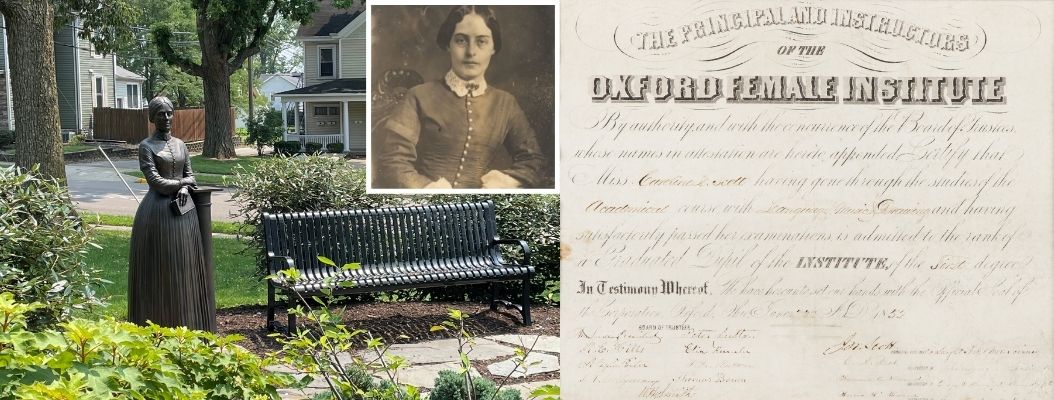
Diploma courtesy of The White House Historical Association
Among the Oxford Female Institute's most notable graduates was Caroline Lavinia Scott (1832-1892), born in Oxford and an inaugural graduate of the Institute in 1852.
Dr. Scott introduced his second daughter to Benjamin Harrison, one of his former students at Farmer's College in Cincinnati. Harrison later transferred to Miami University, and the couple married in 1853. Benjamin Harrison was elected President of the United States in 1888. Caroline Scott Harrison served as First Lady from 1889 until her death from tuberculosis in 1892 - one of the only First Ladies to die in the White House during her husband's term. Well-educated and broadly accomplished, she held lifelong interests in women's rights, music, art, and literature.
Caroline Scott Harrison was also an organizing member of the Daughters of the American Revolution and served as its first national President General while living in Washington. In 1928, the Caroline Scott Chapter of the DAR dedicated the building as the Caroline Scott Harrison Memorial.
A bronze sculpture of Caroline Scott, created in 2018 by artist Jarret K. Hawkins of Studio Hawkins, is based on her graduation portrait and stands today in the west gardens of the OCAC - one of the few public statues in Ohio honoring a First Lady.
Miami University & Oxford Community Arts Center

Miami University used the building as a first-year women's dormitory from 1930 until the mid-1980s, then as co-ed graduate housing until 1996. The building closed in 1998.
Around that time, a group of Oxford residents came together with a shared conviction to establish an arts center and preserve the building. The Oxford Community Arts Center was incorporated on October 29, 2001. This saved the historic building and repurposed it as a community arts center, providing an arts space for adults, families, and children living in and around Oxford. Miami University and the OCAC signed a 50-year lease, updated in November 2022, with a renewal through April 30, 2052.
Today, the OCAC serves over 15,000 participants annually through classes, performances, workshops, and community events - continuing a tradition of education, arts, and community that began on this site over 175 years ago.
Did you once call this place home?
Over 177 years, this building has been filled with stories. It began as the Ox College for Women, then served as a Miami University women’s & graduate student dormitory until the late 1990's. If you lived here, studied here, or have family memories tied to these halls, we’d love to hear your story. Help us preserve the rich history of this space by sharing your memories through the submission of this form. Ox College Alumni Stories.